Back
LLM Interactive Project
ROLE
Experience Designer
TIMELINE
2025
TEAM
Chris Ye; Cheng Peng; Rui Liu
PROJECT BRIEF
Diplomask is a soundproof mask that does your professional translating for you. You speak into it — plainly, honestly, whatever you actually mean — and no one hears it. What they hear instead is your message rendered in fluent corporate English, tone calibrated to whoever you're speaking to.
A dial on the side selects the register: subordinate, peer, or superior. Turn it, and the same sentence becomes condescending encouragement, buzzword-laden camaraderie, or self-effacing flattery. The mask never asks what you meant. It only asks who's listening.
RECOGNITION
Published in Technology | Architecture + Design (TAD)
Exhibited at Cornell Ithaca and Roosevelt Island
Cited in faculty research on AI-mediated communication
Project Statement
Corporate language claims to be neutral — a shared professional standard that makes collaboration efficient. In practice, it functions as a filter: it signals who belongs, and it quietly disadvantages non-native speakers, early-career workers, and anyone who hasn't absorbed the institutional dialect.
Diplomask takes that filter and makes it literal. By automating the translation from what you mean to what you're expected to say, the project asks an uncomfortable question: if this labor can be outsourced to a machine, what exactly were we performing all along — and for whom?

How It Works
Three Modes
The dial doesn't adjust politeness. It adjusts direction — because workplace language changes shape depending on which way it's traveling through the hierarchy. We wrote three prompts, one for each direction:

Written out as tags, the three modes read like a taxonomy of things everyone recognizes but no one names.
Task Flow

System Architecture
Whisper transcribes the wearer's speech. ChatGPT rewrites it according to the selected mode's prompt. Google TTS speaks the result aloud through the mask's external speaker. A button starts and ends recording; the knob switches modes between the three hierarchical registers.
The entire loop takes a few seconds — long enough for the wearer to hear, in a synthetic voice, what they were supposed to have said.


Physical Design
Early forms resembled medical masks — smooth, neutral, benign. As the concept sharpened, so did the object: the final design adds an external cage of rigid straps across the mouth, closer to a muzzle than to protective equipment. Soundproof cotton lines the interior, sealing the wearer's actual voice inside; a speaker mounted at the mouth broadcasts the AI's version outward.
The form is deliberately uncomfortable to look at. A device that makes you more employable should probably look like restraint.
Final Design
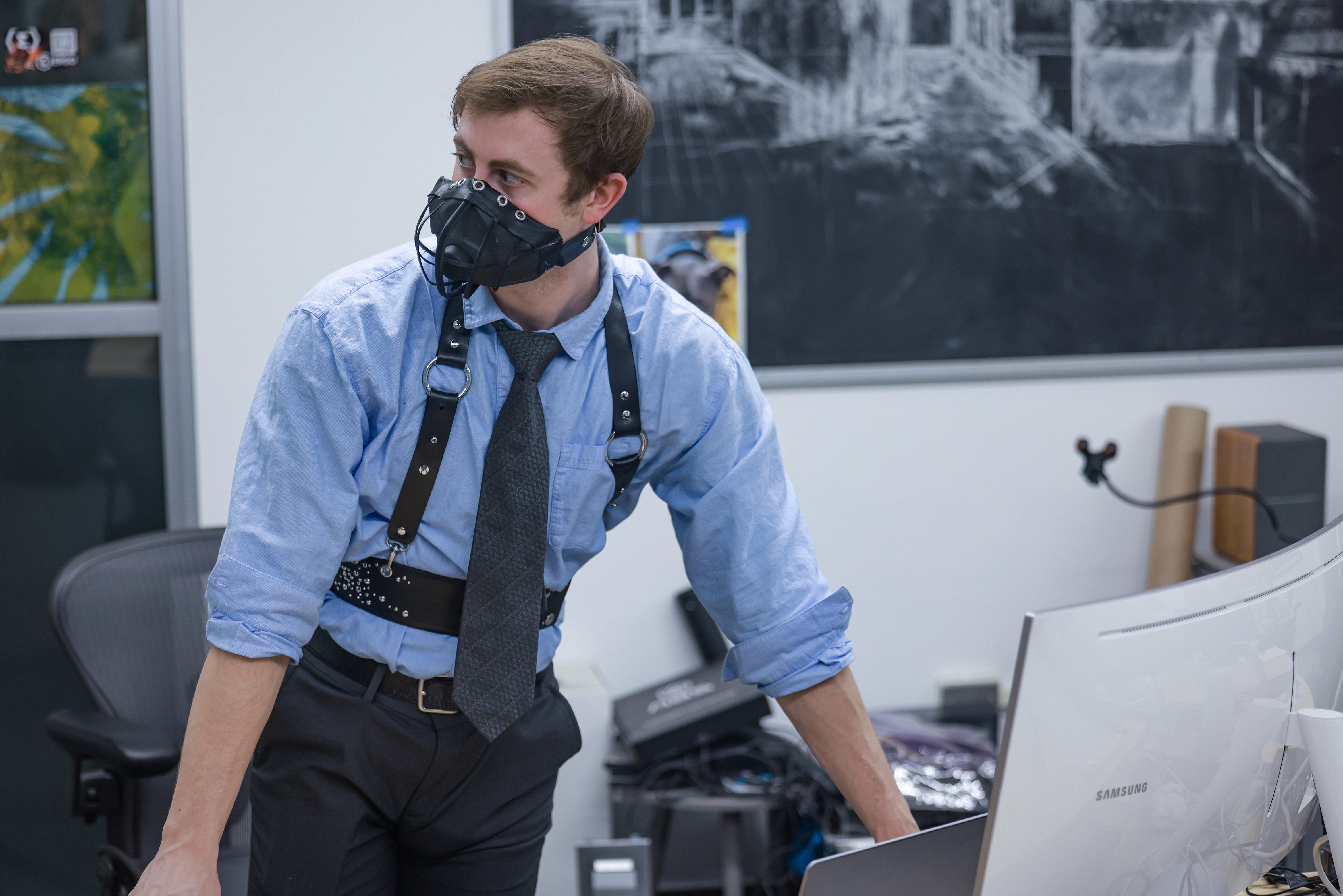
Model: Kobe Phlips

Model: Kobe Phlips


Refelections
Building Diplomask meant writing prompts that we recognized a little too easily. The hardest part wasn't the engineering — it was calibrating each mode until people laughed in the right uncomfortable way, which usually meant we had gotten it accurate rather than exaggerated.
The project has since been published in TAD and exhibited at Cornell Ithaca and Roosevelt Island. In presenting it, the most common reaction wasn't "this is absurd" — it was "where can I buy one." That response is, we think, the actual finding.
