Back
Interactive Kinetic Installation
ROLE
Experience Design, Screen & Projection Design, Material & Touch Design
TIMELINE
2025
TEAM
Chris Ye; Weiching Chen; Yiwen Yang
PROJECT BRIEF
There's someone you haven't texted in months. Not because anything happened — the conversation just stopped, and neither of you noticed when. Flourisa makes that silence visible.
Flourisa is a kinetic installation that gives physical form to the health of our relationships. Each mechanical flower represents one contact in the user's life: when conversations are frequent, the flower stays in full bloom; when messages fade, it slowly wilts.
The bond, however, is never fully lost. Touching a wilted flower makes it bloom again — sending a wordless "flower" message to that person and surfacing a random memory from their shared chat history. In a moment, an unspoken I've been thinking of you travels in both directions.
Inspiration
In an age where messaging is constant but connection is thin, the emotional weight of our interactions is easy to lose track of. Drawing on floriography — the Victorian language of flowers — Flourisa translates that lost nuance back into something physical: blooming, wilting, and the small gesture of reaching out to touch.
Interaction Flow
Flourisa connects to Discord, where an AI system analyzes the frequency of the user's conversations. Each flower is bound to one person, and its physical state becomes a slow, ambient signal of that relationship — full bloom for active contact, wilting for silence.
Touch is the reset. When the user reaches out to a wilted flower, its petals reopen, a random past message or photo appears on the screen behind it, and a flower emoji is sent to that contact — an unspoken gesture that says I'm thinking of you.
What makes the gesture work is its asymmetry: the flower wilts on its own, without asking anything of you. It doesn't remind you, doesn't notify you, doesn't count the days. It simply becomes a little less alive, and waits to be noticed.

Physical Design: Mechanism
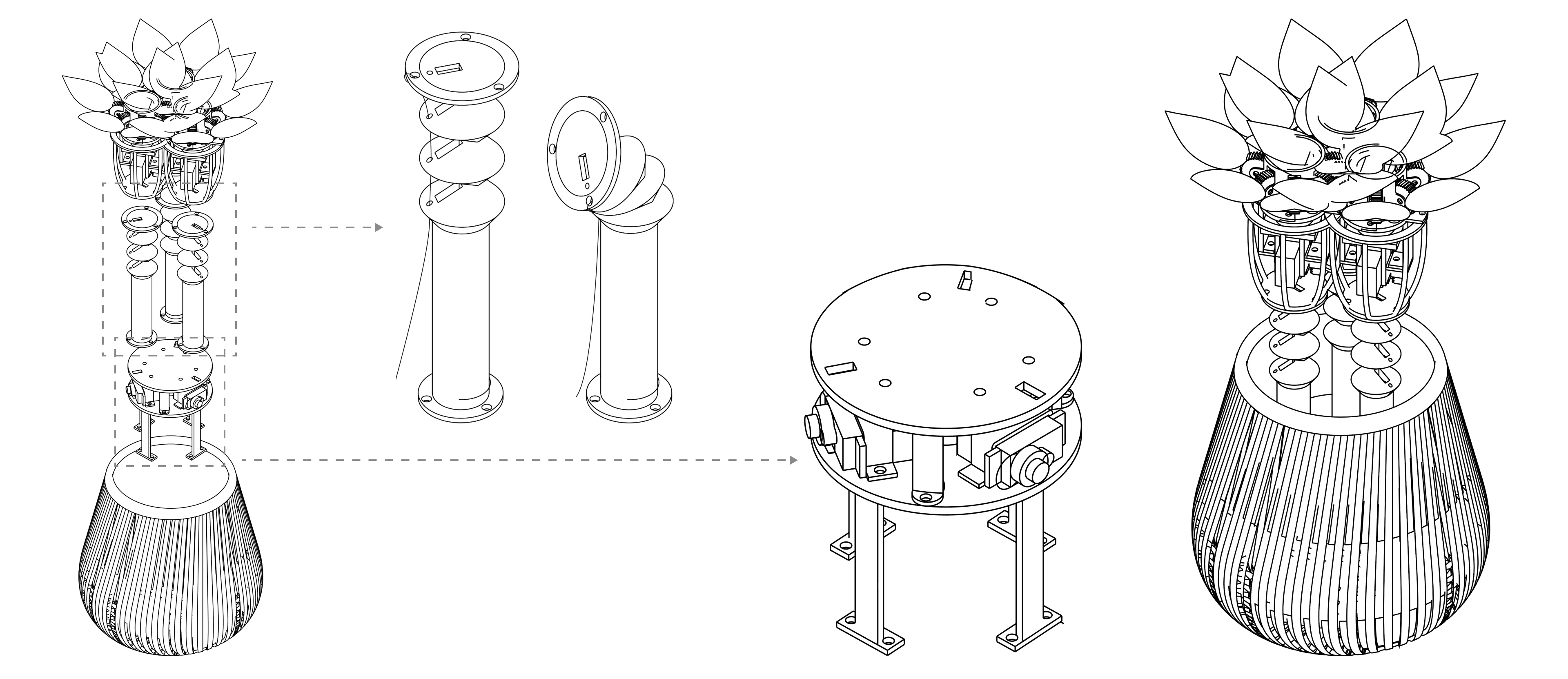
Each flower opens and closes through a gear-driven mechanism housed in its stem: a servo drives a rack-and-pinion assembly that pushes the petal armature open or lets it collapse inward. The vase conceals the control board and wiring for all five flowers, keeping the mechanics invisible from the front while remaining accessible for maintenance.



Physical Design: Material & Touch System
The petals are crafted from crepe paper to keep the flowers light enough for the mechanism to move and delicate enough to read as real. Copper conductive tape traces the petal edges — functioning as the capacitive touch sensor while doubling as decoration, so the technology reads as ornament rather than hardware.


Screen Design

Resting — the conversation scrolls, unread

On touch — a message surfaces
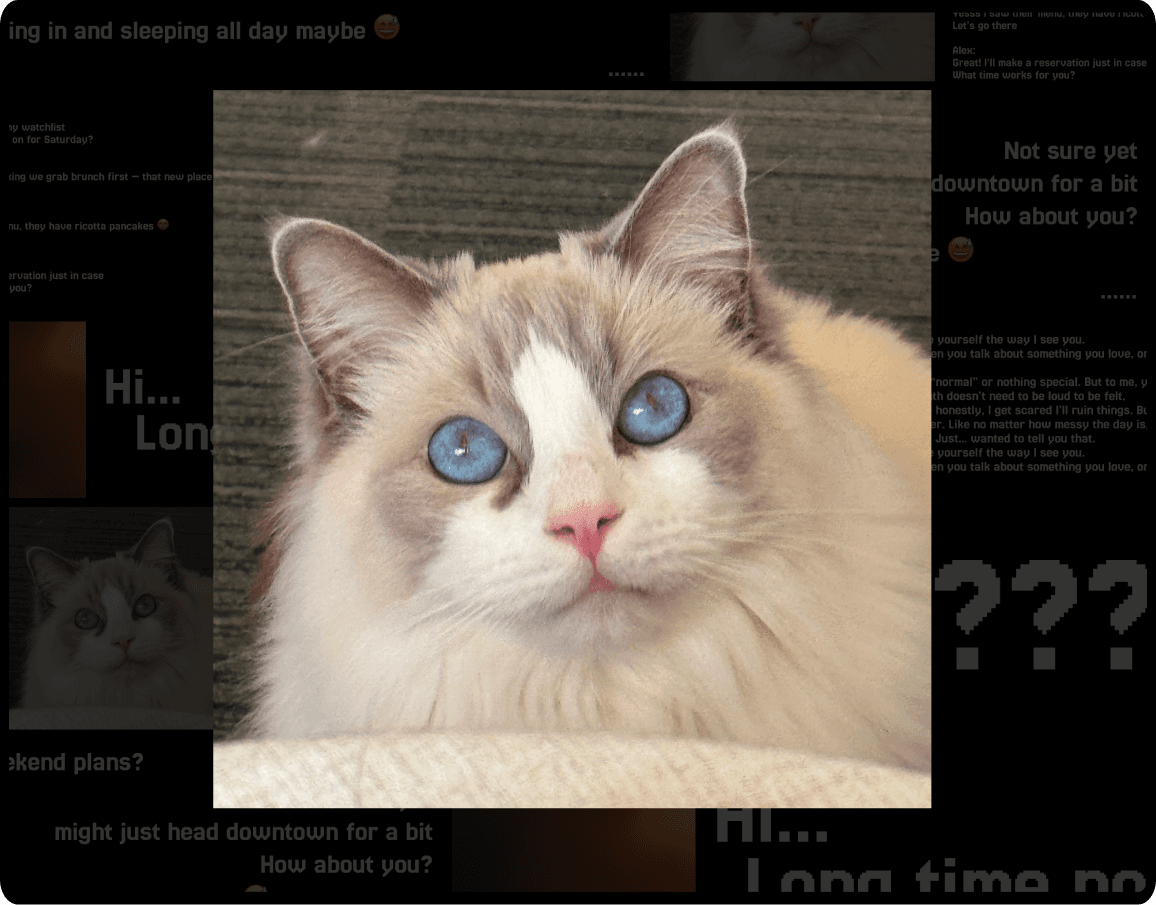
On touch — a photo surfaces
Behind the flowers, a projection carries the digital half of the piece — pulled from the user's actual chat history through the Discord API, then cast onto both the screen and the flowers themselves, so the messages literally land on the petals.
In its resting state, the full conversation scrolls slowly and unreadably, like background noise — years of exchange reduced to texture. The moment a wilted flower is touched, the system pulls one fragment at random and enlarges it: a line of text, or a photo.
The randomness is deliberate. There is no algorithm choosing the most meaningful memory, no "your highlights from 2023." Whatever surfaces is whatever surfaces — and the accident of it is what makes it feel like remembering rather than retrieving.

A Moment with Flourisa
You come home. On the table, one flower has closed in on itself — the one that belongs to a friend from another city. You reach out and touch its petals. It opens. Behind it, on the wall, a photo from three years ago appears: the two of you, somewhere neither of you has been back to. On her phone, a flower arrives.
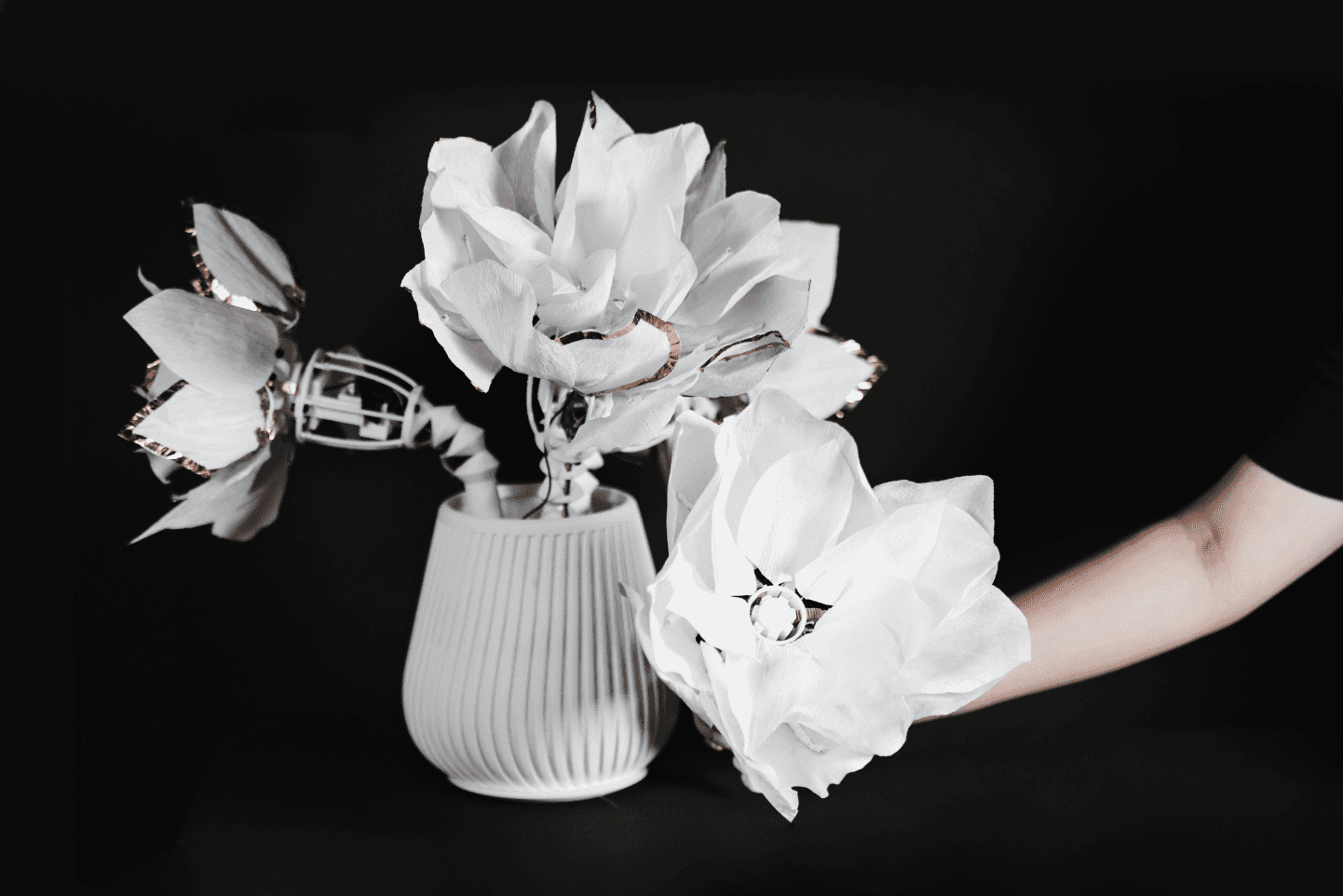

Final Design


Flourisa asks what it would mean to feel our relationships instead of scrolling past them — to walk by a wilting flower and remember someone we've been meaning to text. The project taught us that emotional interfaces work best when they ask for very little: no app, no notification, just a flower that quietly changes, and a hand that reaches out.
