Back
Daily Pet Care APP
ROLE
Product Designer, User Researcher
TIMELINE
2026
TEAM
Solo Project
PROJECT BRIEF
Nuzzle is a pet care app that tracks your dog's life through your phone — no collar, no manual logging — and shows it next to your own. Walks, distance, time outside: two sets of numbers, one shared week.
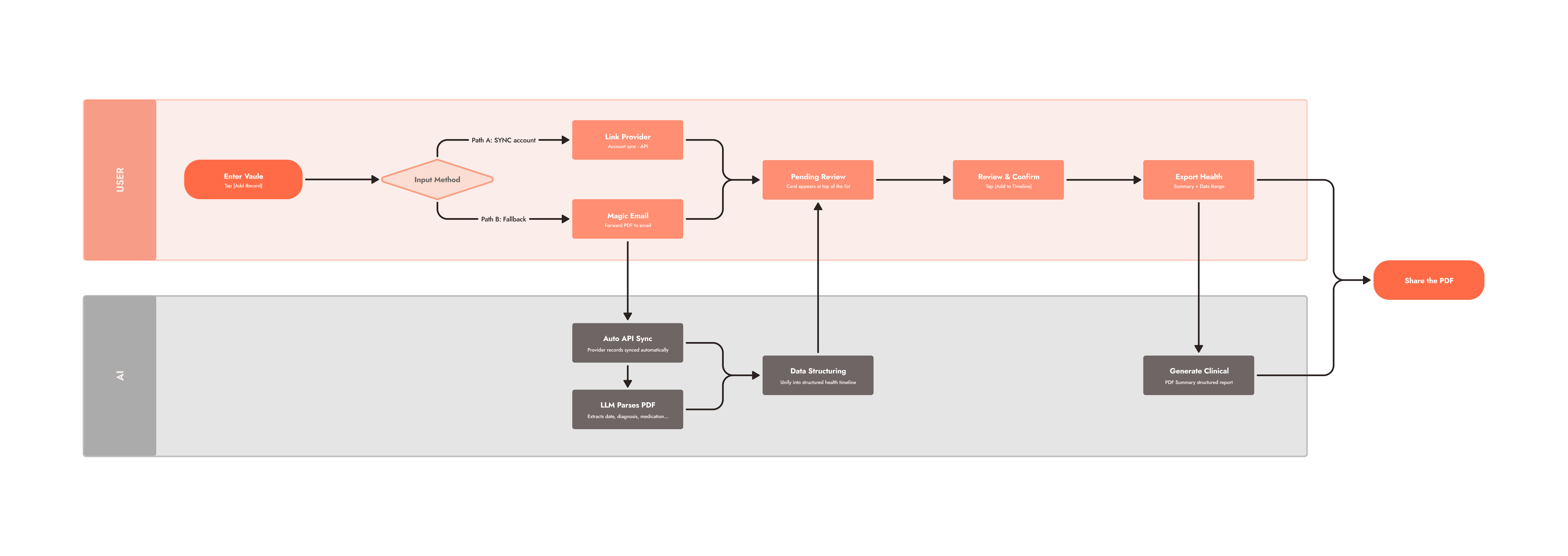
Behind it sits a unified health record pulled from every clinic you've visited, and breed-aware AI that flags risks before symptoms appear. Most products treat the pet as something to monitor. Nuzzle treats tracking as evidence of a bond.

Problems

Pet owners spend more on their animals than ever — and know less about them than they think. Health records live in three different clinic portals and a folder of PDFs. Activity tracking means either buying a collar the pet never wanted, or logging walks by hand until you stop. Seventy percent of pet health apps are abandoned within a hundred days, and manual entry is the single biggest reason.
The tools exist. The problem is that all of them ask the owner to do more work in exchange for information about a relationship they're already living.
User Research
I interviewed ten dog owners, split evenly between large and small breeds, and evenly between people raising their dogs in the U.S. and in China. Most were students or early-career professionals between 20 and 30 — the group that spends the most on pets and has the least time to spend on paperwork.
Three patterns came up in almost every conversation:
Logging dies within weeks.
Everyone had downloaded a tracking app. Almost no one was still using it. The apps didn't fail because they lacked features — they failed because they asked for input at the end of a long day, and caring for a pet already fills that time.
Records live everywhere except one place.
Vet visits produce PDFs in email threads, portals with forgotten passwords, and paper folders. Owners who'd changed clinics — or moved countries — had no continuous history at all, which meant every new vet started from zero.
The worry is about what you can't see.
Owners of quiet or stoic animals described a specific anxiety: by the time something is visible, it's already serious. What they wanted wasn't more data — it was a baseline, so a change would register as a change.
These patterns split into two distinct user types — one optimizing for time, the other for peace of mind.
Persona
Both personas are U.S.-based, reflecting the initial launch market; interviews included owners in China, whose experiences with fragmented records were consistent across both countries

Competitive Landscape

No competitor combines passive phone-based tracking, breed-specific AI care, and cross-vet record consolidation.
Each category solves one piece and leaves the others open: smart collars track well but don't consolidate records; logging apps consolidate but die from manual entry; clinic apps hold records but only their own.
Design Principle
The design of Nuzzle should follow:
01
A QUIET COMPANION
02
HARDWARE-FREE
03
A RELATIONSHIP LENS
04
VET-GRADE AND WARM
Key Features


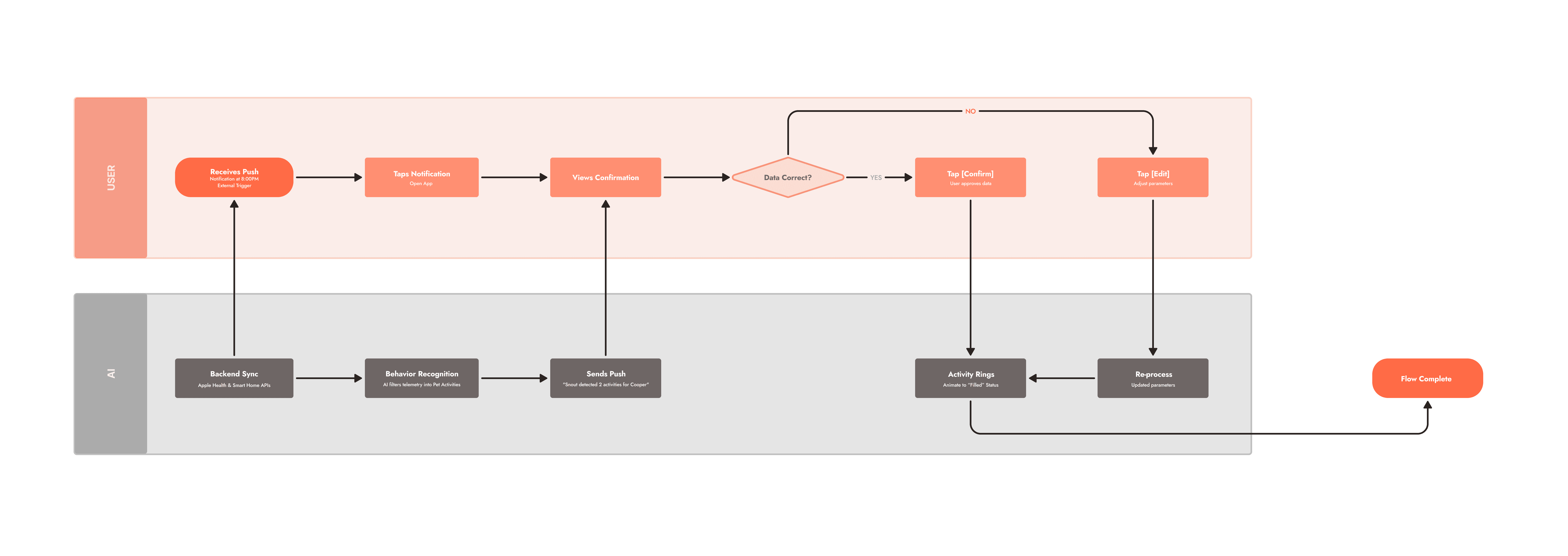
Userflow

Brand Identity

UI System

Reflection
I live with a cat, and most of my day is shaped by hers. What drew me to this project wasn't the pet care market — it was the suspicion that the relationship between a person and an animal isn't ownership at all, but something closer to symbiosis: two lives quietly rearranging each other. The design followed from that. Nothing the animal has to wear, nothing the owner has to remember, and tracking framed as a record of the bond rather than surveillance of a pet.
The hardest constraint turned out to be restraint. Every feature I considered adding — a daily summary, a streak reminder, a nudge to log the walk I might have missed — made the product more capable and less likely to survive past week three. The research was unambiguous on this: apps don't die from missing features, they die from asking. So most of the design work was deciding what the system should handle silently, and reducing the user's role to a single tap of confirmation.
If I continued, the next step would be testing whether passive detection is accurate enough to be trusted without verification. Right now the flow asks users to confirm what the system detected — a safeguard that also quietly reintroduces a daily task. The version I'd want to build is one where confirmation becomes optional, and the app earns the right to stop asking.
