Back
Social Companion Robot
ROLE
Product Designer, User Researcher
TIMELINE
2025
TEAM
Chris Ye; Weiching Chen; Xiaocheng Li
PROJECT BRIEF
WALKIE is a plush keychain that notices what you don't. Worn on a bag, it senses when someone nearby shares your interests — or matches what you're looking for — and reacts: eyes widening, blinking, tracking toward the person it found.
No notification, no profile to swipe. Just a small companion that makes a moment visible while both people are still standing in it.

Problem Statement
Cities are dense with people and empty of introductions. Digital-first habits have made face-to-face initiation feel less natural and more intimidating — 64.2% of young adults report feeling "socially blocked," unable to start an in-person interaction even when they want to.
The result is a strange asymmetry: real encounters offer more emotional reward than online ones, yet they're the ones people hesitate to act on. The first move never happens, and the moment passes.


Research
Dating apps are efficient at matching and bad at meeting. The funnel tells the story — millions of swipes narrow to a handful of matches, fewer messages, fewer dates. Most of the product's design effort goes into the top of the funnel; almost none goes into the part where two people are actually in the same room.

Efficiency and authenticity pull apart. Mapping social platforms against offline social activity showed a clean trade-off: digital platforms maximize speed and reach but struggle with trust and real-world follow-through; offline encounters produce deeper bonds but don't scale.

Hybrid attempts fail on control. Case studies like Lets Movie build a shared context to reduce awkwardness — but users lose the ability to choose who they meet, and trust erodes. Any hybrid model has to keep the user in control of the encounter.
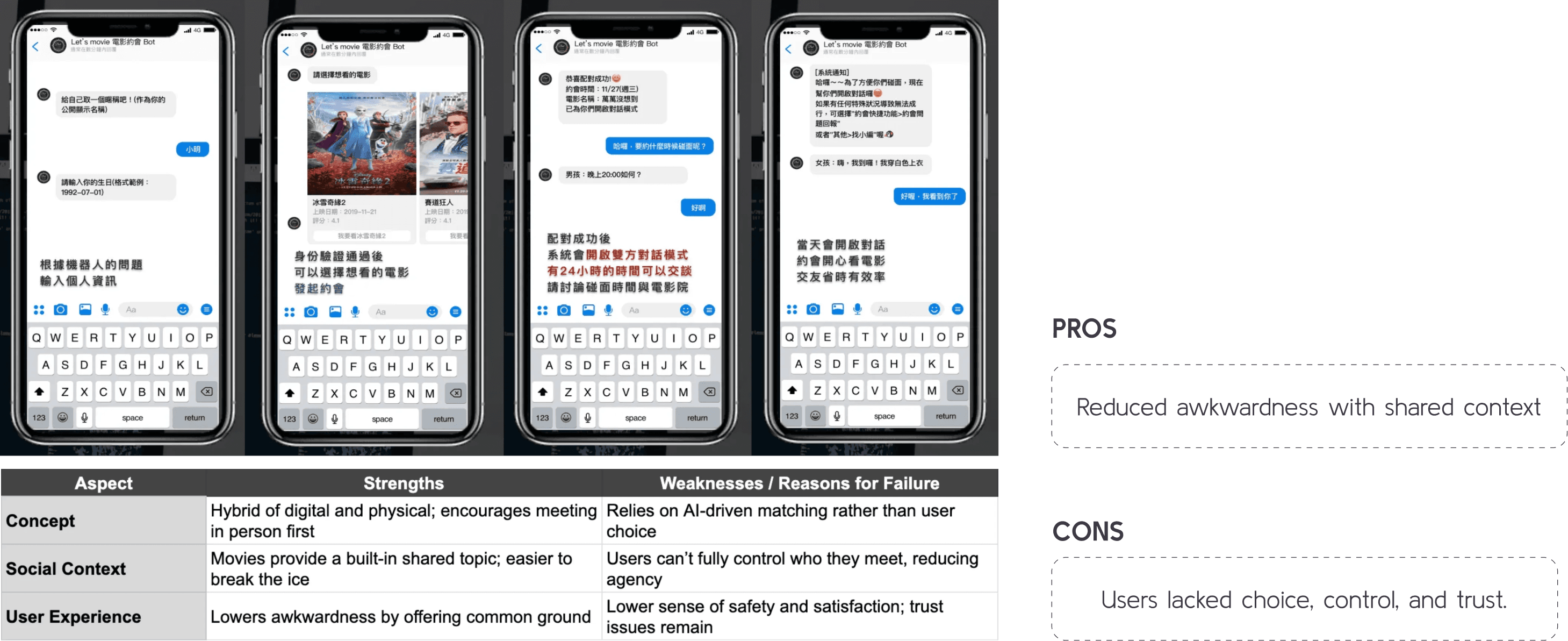
Which left the question we actually had to answer: how do you get two people to meet in person from the very start, without taking the choice away from either of them?
Form Exploration


We mapped the possible form factors against three requirements: visible enough to be noticed by someone else, comfortable enough to carry every day, and social enough that reacting to a stranger doesn't feel invasive.
Robots were too conspicuous. Wearables were too private — a vibration on your wrist tells you something, but tells the other person nothing. Ambient devices don't travel. What worked was the charm: a keychain occupies a social middle ground, publicly visible but low-stakes, already a thing people hang on bags to say something about themselves.
From there the question became what kind of creature it should be. We iterated through dozens of head and body proportions, converging on a form that reads as a pet rather than a device — soft shell, oversized eyes, small magnet-embedded arms that let it gesture.
Eye Language
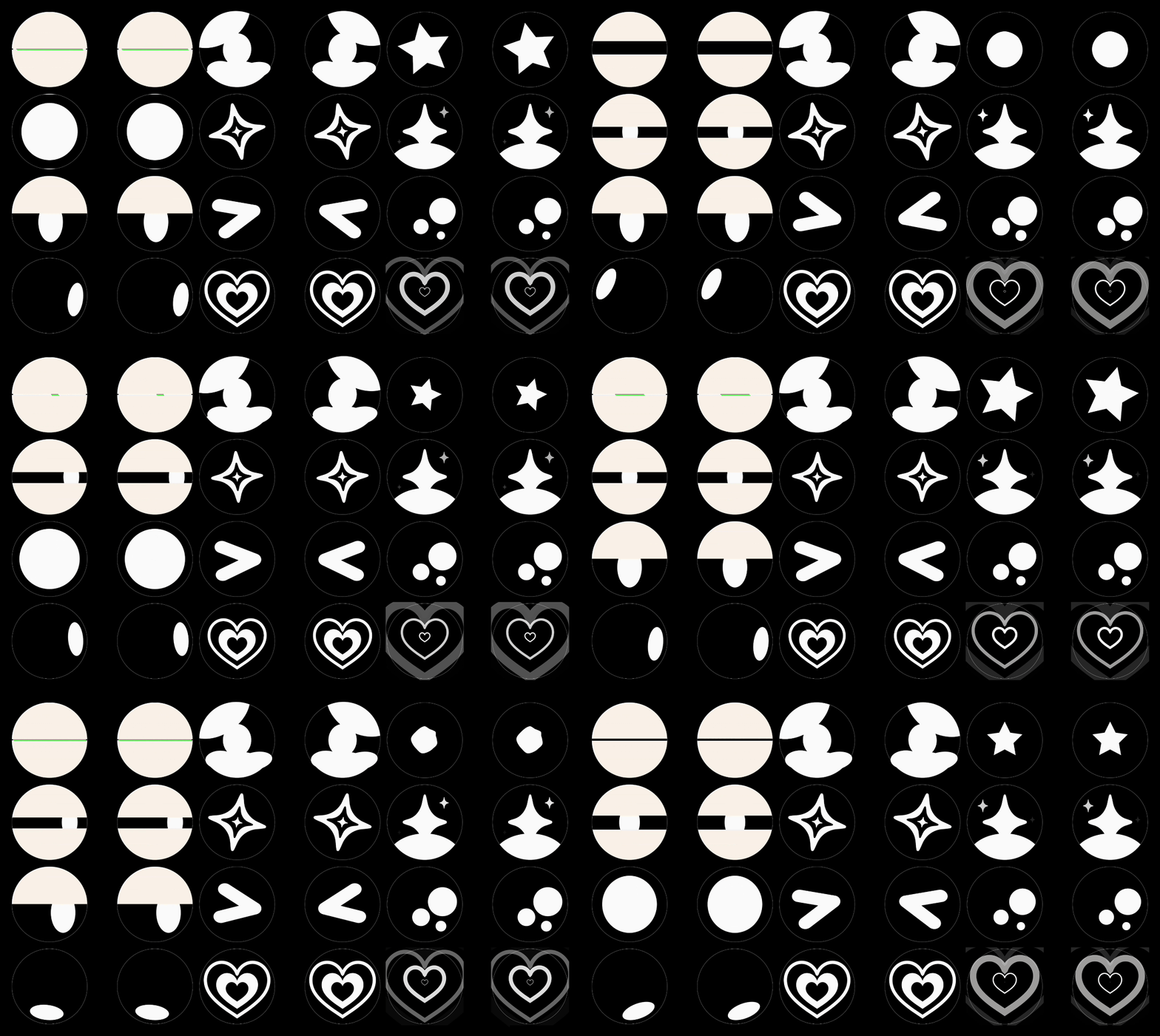
WALKIE has no screen, no speaker, and no text. Everything it communicates happens through two circular displays.
The design study started with human and illustrated eyes — how much emotion survives when you remove eyebrows, pupillary detail, and facial context. The answer is: more than expected, but only if the shapes are simplified past realism.

The final system has two layers. Basic states cover the device's own condition — waking, sleeping, charging, idle, searching. Matching states communicate what Walkie has found: scanning, target detected, direction of the match, strength of the match, mutual interest confirmed.
The constraint that shaped everything: a stranger should be able to read Walkie's state from a few meters away, without knowing what the product is.
System & Hardware
Walkie pairs BLE proximity detection with GPS to identify nearby users whose profiles match the wearer's preferences. The companion app handles everything Walkie deliberately doesn't: profile setup, matching preferences, personality configuration, and the encounter history you review later.
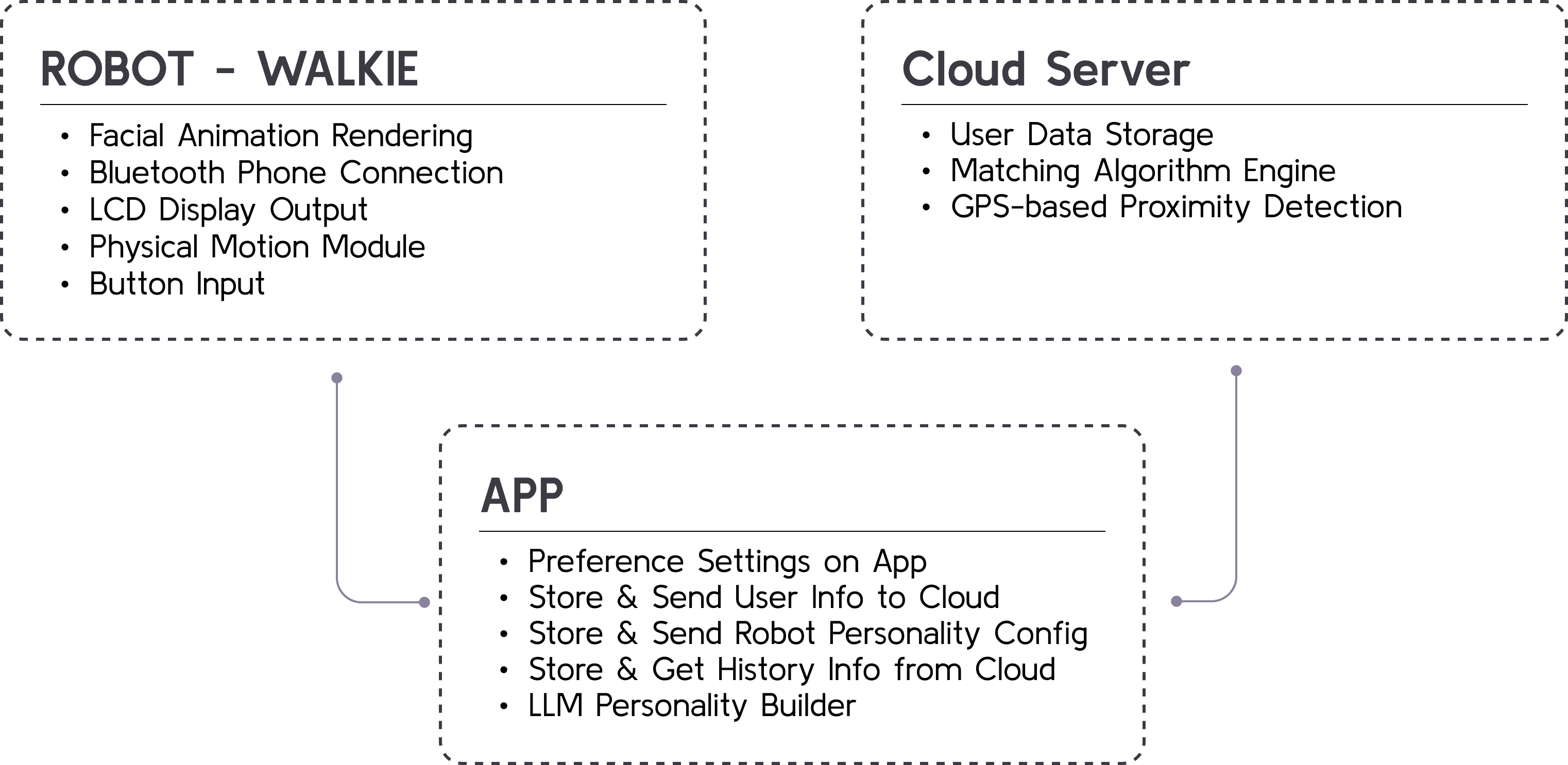
Working prototype. We built a functional prototype on a Raspberry Pi 5 driving dual circular LCDs (GC9A01), with Bluetooth pairing and button input. It validates the core interaction — proximity detection triggering the eye display — at a scale far larger than the final product would be.


Physical Product Prototype
The App
The app stays deliberately thin. Walkie handles the encounter; the app handles setup and aftermath — preferences, personality settings, the map of where you crossed paths with someone, and the option to reach out afterward if both sides agreed.

Reflections
The hardest part of this project wasn't the sensing — it was deciding how little the device should say. Every added signal (a name, a photo, a compatibility score) made Walkie more useful and less usable, because the more it told you about the person across the street, the more it became the thing you looked at instead of them.
What we landed on is a device that can only point. It tells you someone is there, and then it gets out of the way.


